It’s the fifth question of Double Jeopardy, and I’ve found the last Daily Double of the game. I’m barely recovered from calming myself down after betting everything I had just 3 questions earlier to take the lead over a tough opponent, and I need to decide how much I want to bet on this last Daily Double. Here is a list of factors I am trying to weigh on the fly:
I have a lead of $12,000 to my opponents’ $7,000 and $2,800.
There will be no more Daily Doubles after this one.
The returning champion has not been much of a factor in this game.
The category is Chemical Elements, a category I’m most comfortable with of all the categories on the board, and it’s a $1200 clue, which is not too difficult of a clue.
There is a lot of money left on the board, so I cannot guarantee a runaway if I max bet and get it right.
The $7,000 player is a tough opponent, and I am not positive I can come from behind in regular play if I bet too much and get it wrong.
At the same time, I also expect her to win the bulk of the remaining questions, so there is value in taking some risk to pad my lead.
Holy shit I am currently in the lead in a game of Jeopardy and Alex Trebek is right there and everyone I know will be watching this and I really really really do not want to lose this game please just let me win one game I swear I won’t ask for anything else.
As you can see, it’s a lot to take in.
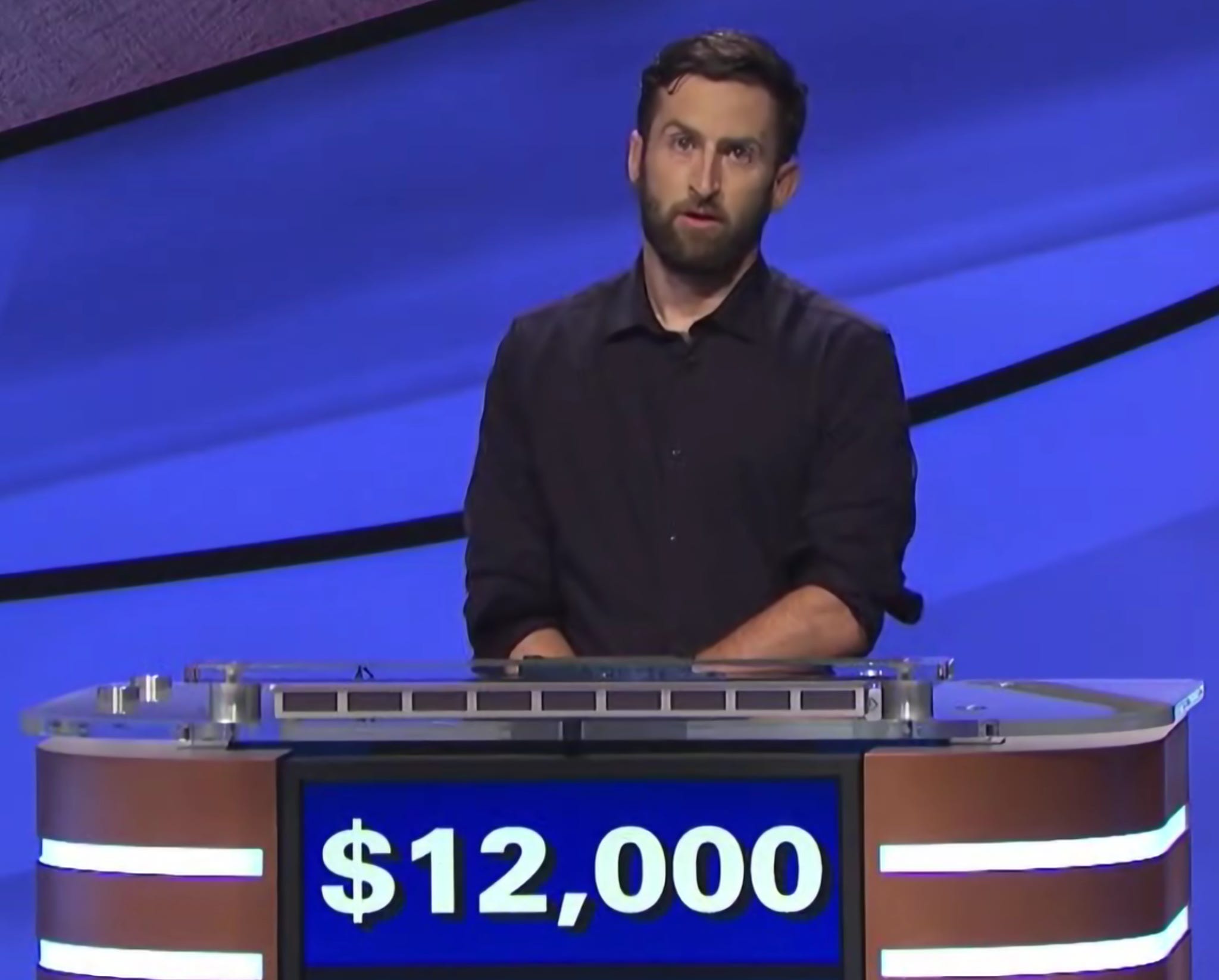
I stared at the scores for what felt like 30 seconds, and in reality was probably closer to 5. To this day, I have no idea if the time elapsed on TV was the same amount in real life or if the show edited out a drawn out pause from my deliberating on what to wager. (There are chunks of the tape day I didn’t remember until I saw the episode air. It’s a weird experience.) All of those factors went through my mind, and I reduced it to a choice: $4,000 or $6,000? Erring on the side of caution and wanting to maintain a lead no matter what (without knowing if that was still the optimal choice), I went with $4,000. Was that the right decision? And if I wanted to evaluate that decision to see if it was the right one (and for that matter, also determine if my prior all-in Daily Double was the right move), how would I do so?
One of the more practical applications of win probabilities in sports analytics has been using them to evaluate tactical decisions. The most famous example you might see a lot is evaluating decisions on 4th down in football, where the three main play choices (go for it, attempt a field goal, or punt) are presented as play call options. Using some basic assumptions, each of the play call outcomes are modeled as resulting game states, and the resulting game states are converted into win probabilities. This enables evaluating each play calling option independently on the basis of change in win probability: the win probability if the call succeeds versus if it fails, and seeing which play calling option has the best expected change in win probability, based on the success rate of each option. The reason a win probability model is essential to this evaluation is the win probability model prices in everything about the game states in those what-if scenarios (down, distance, scores, time left in the game, etc.) to allow apples-to-apples comparisons of the results of each option and see which one produces the best expected change in win probability.
We can use this same framework to evaluate Daily Double wagering choices in Jeopardy. The basic approach is as follows:
For a given wager size, calculate the scores and resultant win probabilities of all contestants if the answer is correct, and calculate the scores and resultant win probabilities of all contestants if the answer is wrong.
Estimate the chance that the wagering player gets the question right, aka the conversion rate.
The wagering player’s expected change in win probability is (probability of answer right * their win probability if they get it right) - (probability of answer wrong * their win probability if they get it wrong).
Calculate the changes in win probabilities for all wager sizes, and for each hypothetical value of the conversion rate, determine the wagering size that maximizes their expected change in win probability.
The win probability model makes the game state to win probability part “easy”, but estimating a player’s conversion rate is a little tricker. Every player’s conversion rate will be some combination of their base ability, how good they are in that category, and the value of the clue (higher value clues are generally harder). While we can’t ever get an estimate of a specific player’s conversion rate, we can at least get historical averages for all players for each clue value so we can ballpark the answer.
This is how the Daily Double Wagering Strategy tool works: for a given game scenario where a Daily Double came up, it calculates the results for every hypothetical wager a player could make, combines them with all the potential get rates, and displays the optimal wager amount for that player. Here’s how the tool looks for the Daily Double attempt I described above:
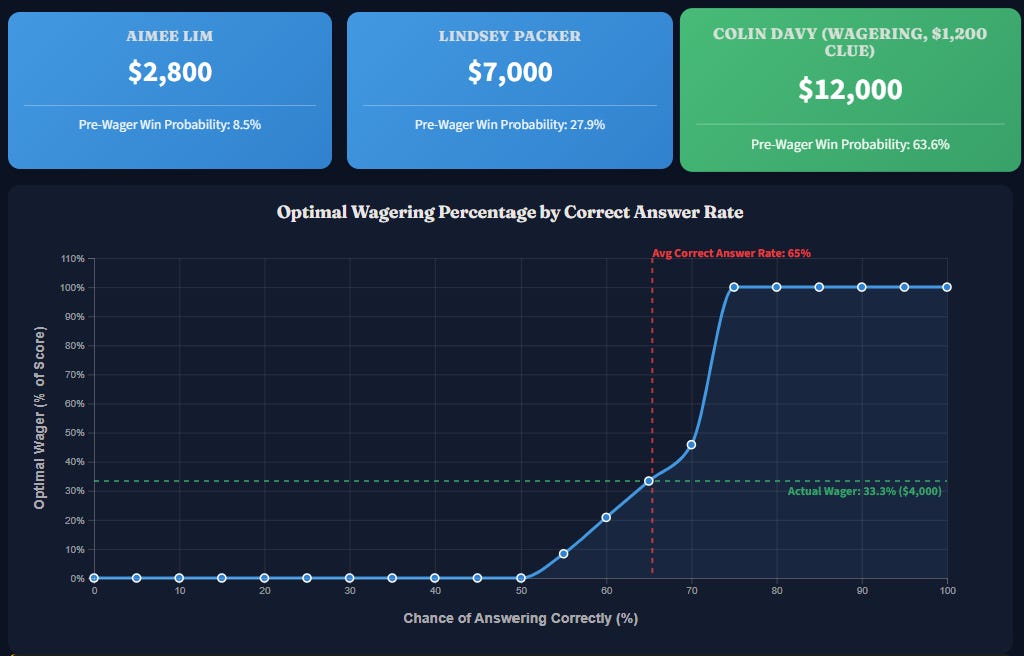
Here’s how to read this graph:
The red vertical line is the average get rate (conversion rate) for all $1200 clues- a rough estimate of what my conversion rate would be.
The x-axis is all possible conversion rates I could have for the question.
The y-axis is the optimal percentage of my bankroll I should be wagering at that get rate in order to maximize my expected change in win probability.
The quick and dirty version: if the red and green lines meet close to the blue curve, it was a good wager.
We can also hover over the dots on the blue line graph to get a more granular look at different wager sizes for different get rates:
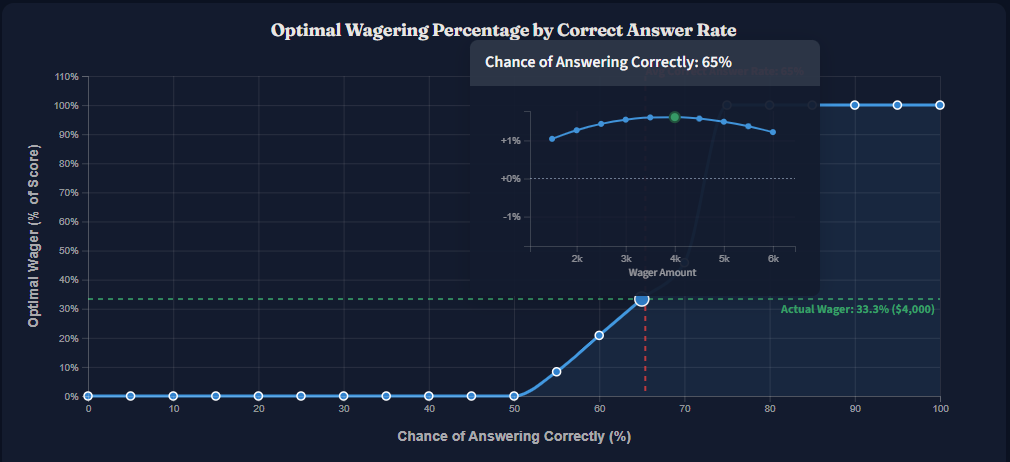
This convex curve is pretty typical of any process where you’re trying to find an optimal decision point. Betting too little means you’re not taking advantage enough of the favorable spot you’re in, but betting too much means you’re throwing away too much win equity in the event that you get it wrong. We can hover over those green dots as well to see the calculations explicitly laid out as well:
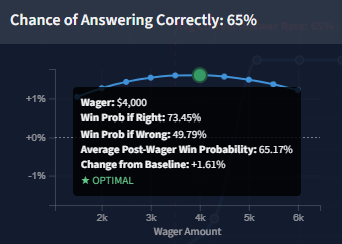
I find it helpful to zoom in on the curves for different get rates like that, because you get an indirect understanding of the sensitivities around different variables. Betting $3500 is the optimal amount at this get rate and results in an expected gain of 1.45%, so even if I had an on the nose get rate of 65% for this category, my actual bet of $4000 results in an expected gain of 1.41%. That 0.04% difference is not remotely significant, especially since I have no illusions that this analysis process is significant to that degree of precision. Model-based approaches like these for evaluation strategic decisions benefit from remembering these models are sledgehammers, not scalpels, and are most useful for ballparking decisions and highlighting large gaps between actual and optimal wagering to help inform future wagering decisions.
What does an example of a large gap between actual and optimal look like? Let’s look at the last Daily Double of one of my favorite games from season 42, when Prasad Patil dethroned Vickie Talvola:
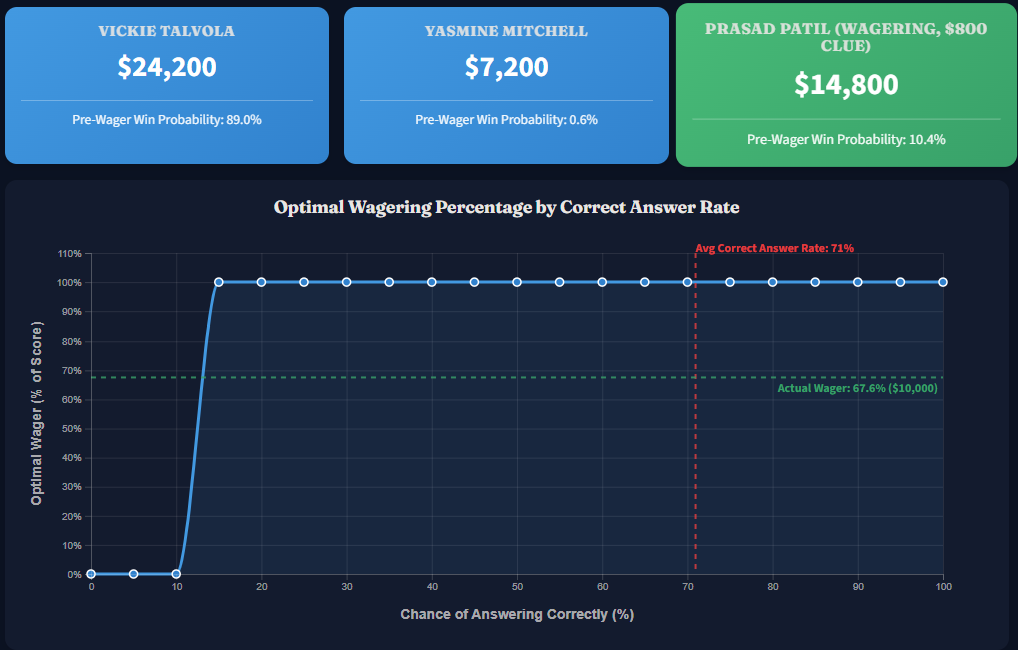
On the surface, I can see Prasad’s thinking: bet just enough to take a lead over Vickie, but leave something in the tank to still participate in Final Jeopardy. The moment absolutely requires a large bet, and good on Prasad for stepping up to the plate and making one, but our model-based approach says that even without knowing Prasad’s “true” get rate for this Daily Double, even if it’s as low as 30%, he would benefit from going all-in. It’s not a close decision, either: even at a conservative estimate of a 60% get rate for an $800 question, betting $10,000 results in an expected win probability gain of about 24%, but betting everything results in an expected win probability gain of around 35%, which is a massive difference:
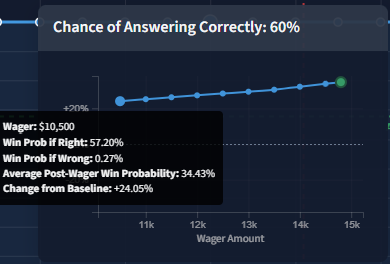
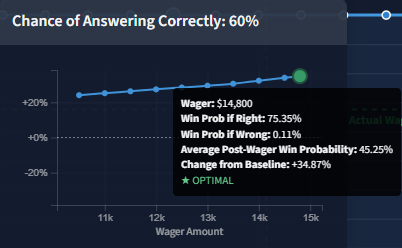
Spelling out the scenarios makes it a little more intuitive. In either scenario, if you get it wrong, you’re just as functionally dead in the water with 8 questions left and no more Daily Doubles you can find to make up any lost ground. But the $5400 lead you get from max betting is so much more valuable than the the $600 lead you get from betting $10,000, because there’s not enough questions and/or money left on the board to overtake that lead heading into Final Jeopardy, an absolutely critical condition to maximizing your chances of winning. To the untrained eye, both bets might seem big enough, but when we look into the numbers, there’s a massive amount of win equity being left on the table.
I want to pause here and be cognizant of the fact that I’m picking apart another contestant’s wagering choices here. Prasad didn’t sign up for catching strays from some guy picking apart his choices in an incredibly high stress environment in the same way that NFL coaches sign up for intense scrutiny of all of their decisions: the latter group is a bunch of millionaires who knowingly took an incredibly stressful job, and us contestants are pretty much your neighbors and coworkers thrust into the spotlight for a day. My intent is not to pick apart someone’s decisions for the sake of picking them apart, but rather to use those decisions as specific examples to show how Jeopardy looks through the prism of numbers and analytics. I’m sure there are plenty of viewers and contestants who didn’t necessarily sign up for doing math puzzles and just want to engage in the trivia aspect of the show, but like it or not, Jeopardy is a contest with a specific set of rules and incentives, and like all contests, there are enormous benefits to those who are able to engage in the analytic side of evaluating strategies and decisions, and that will be true of literally any contest where a score is kept.
My intent in highlighting examples like these is to illustrate the benefits of knowing things like analytics-driven wagering strategies in the hopes that it will encourage more optimal play. Not only does optimal play encourage more exciting gameplay (who doesn’t love aggressive wagering!), my hope is that it also helps prospective contestants mentally prepare ahead of time for what they can do to maximize their chances of success. In that first Daily Double I uncovered, I remember being terrified: I knew from my own preparation that taking risk was necessary if I were to find myself trailing a good opponent, and that an all-in wager would be one of my best chances of success. There’s a huge gap between knowing that beforehand and pulling the trigger in the moment: your brain is being squeezed like a vice, and you still need to retain enough cognition in the moment to actually do that whole “correctly answer the question you were asked” thing in a high pressure moment. I remember being squeezed by the moment, but in the middle of it, finding an important mental backstop of “I know this is mathematically the right thing to do”. That anchor was enough to pull myself together in the moment, dig deep and find the answer, and eventually keep fighting forward and eventually call myself a Jeopardy champion. I hope that with approaches like these, future contestants can create their own backstops so we can see more aggressive, high-quality Jeopardy games in the future.